הפורום הישראלי לפסיכואנליזה ופסיכותרפיה התייחסותית הנו קהילה המאגדת אנשי מקצוע המטפלים בהשראת החשיבה ההתייחסותית. חברי הפורום שואפים לפיתוח פרספקטיבות התייחסותיות ולדיאלוג עם גישות שונות לאנליזה ופסיכותרפיה
מי אנחנו?
מה אנחנו עושים?

האזינו לביצוע יש מקום - כהן גדול
יש מקום / יאיר הררי
מילים:
יאיר הררי, איתי צוק ומיטל מיכאלי
לחן:
יאיר הררי ואיתי צוק
מהעמק הכי נמוך
תעלה ברכה
גם בחדר הכי חשוך
יאיר כוכב
מהכעס הכי גדול
תצא שמחה
(יש מקום לכעס)
מהפחד הכי קשה
תבוא תקווה
(יש מקום לפחד)
ילד משחק
בצעצועי כאב
מרכיב ומפרק
לומד איך לאהוב
מהכעס הכי גדול
תצא שמחה
(יש מקום לכעס)
מהפחד הכי קשה
תבוא תקווה
(יש מקום לפחד)
ילד משחק
בצעצועי כאב
מרכיב ומפרק
לומד איך לאהוב
יש מקום (יש מקום לכעס)
יש מקום (יש מקום לפחד)
יש מקום (יש מקום לכעס)
יש מקום (יש מקום לפחד)
חברי וחברות יקרים ויקרות,
לפני מספר ימים חזרו הילדים והילדות לגנים ולבתי הספר. ההורים והסבים והסבתות חזרו גם הם לשגרה, לכמה ימים, ועוד מעט שנה עברית חדשה מפציעה.
הנה בפתח השלכת, ואחריה החורף, ופריחה חדשה שתבוא.
החדש מבקש להפציע, גם במחיר של פציעה. הופך, מטלטל ומשנה, שוקל לרגע, נושא ונותן, מחפש לפרוץ, למצוא דרך אחרת, לבטא את מה שעוד לא בא לידי ביטוי, לחולל שינוי.
כמה כולנו כמהים וצמאים לו – לחדש. כמה אנחנו מחכים שיבוא, שלוש שנים אחרי.
אני משתף אתכם ואתכן שאנחנו עדיין בעיצומו של הדיאלוג להחזרתו של חברנו, ד"ר מיכה וייס, לבורד הבינלאומי. מי שפספס את הפרקים הקודמים – השתלשלות העניינים מצורפת מטה.
בתוך הדיאלוג, שהפך למאבק, התברר לנו שהעניין קשור לא רק בהסרת המועמדות של מיכה, אלא גם באופיו של הארגון הבינלאומי, ובשמירה על צביונו הפלורליסטי והדמוקרטי, תוך שיתוף ושקיפות.
מצאנו את עצמנו מתגבשים לשתי החלטות:
1. לא באנו "לנצח" את הארגון הבינלאומי. אין לנו הרצון והכוחות לכך. הארגון הוא גם שלנו, כך שאם ננצח – נפסיד.
עם זאת, לקחנו על עצמנו כמשימה ליידע ולעורר שיח על מה שאירע, כדי שבסופו של דבר ישתנו דברים בהתנהלות הארגון. אנו פועלים ופועלות בצורה מקפת בנושא הזה, ומקבלים הזדהות והבנה מעצימות. אנחנו מאמינים ש"אם לא מחר, אז מחרתיים".
2. התגבשה אצלנו ההבנה שבצד המאבק הלגיטימי, אנחנו רוצים, מעודדים ומעודדות אתכם ואתכן להגיש כמה שיותר הצעות להרצאות לכנס הבינלאומי הקרוב ברומא, ובעיקר – להירשם לכנס.
באופן פרדוקסלי, המחאה שלנו היא בהשתתפותנו בכנס.
אני רוצה להודות לחברי "המעטפת", חבורה יקרה של אנשי הפורום שהיו, ועדיין, שותפים פעילים איתי בחשיבה ובהחזקת המשבר הזה.
תודה מכל הלב לחנה אולמן, מיטשל בקר, מיכה וייס, נוגה אריאל-גלור, נגה גוגנהיים, שלומית גדות ושרון זיו-ביימן.
הולך להיות כנס מרתק ברומא. ומי שהיה בכנס ברומא ב-2016 זוכר עד כמה האירוח האיטלקי נדיב וייחודי, וכמה יפה ומונומנטלית רומא. פרטים על הכנס מצורפים מטה.
בחודש שעבר הלך מן העולם איש יוצא דופן – בחשיבה שלו, במקוריות, באומץ וברעננות.
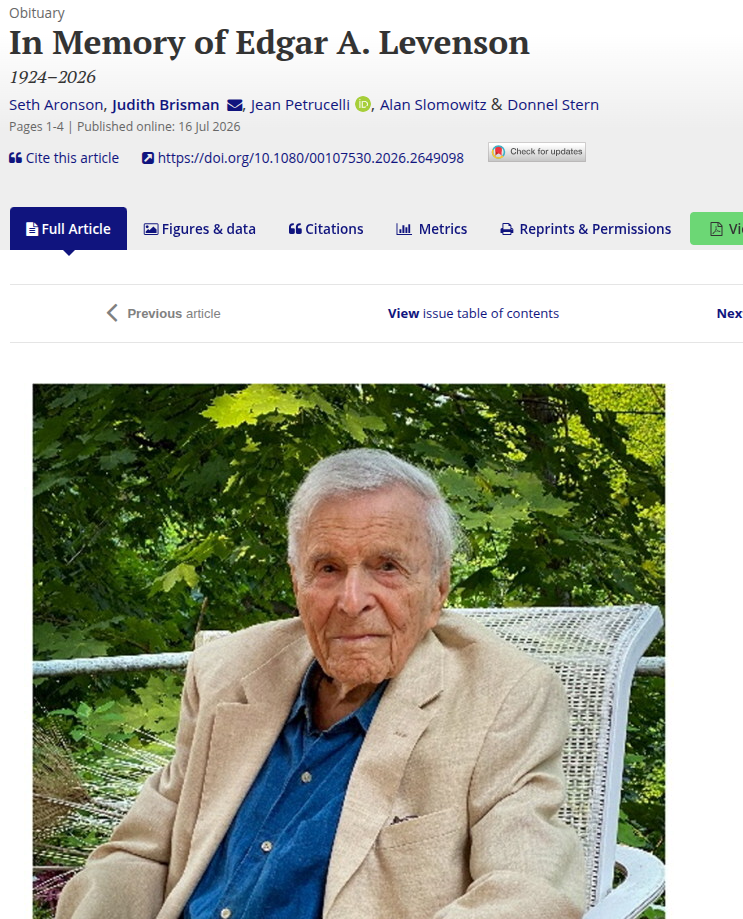
אדגר לוינסון, ממייסדי הגישה האינטרפרסונלית, ובעל השפעה גדולה על הגישה ההתייחסותית ועל תיאוריות השדה, שחי בדעה צלולה ומקורית, ובבהירות כאוטית וגמישה, 101 שנים.
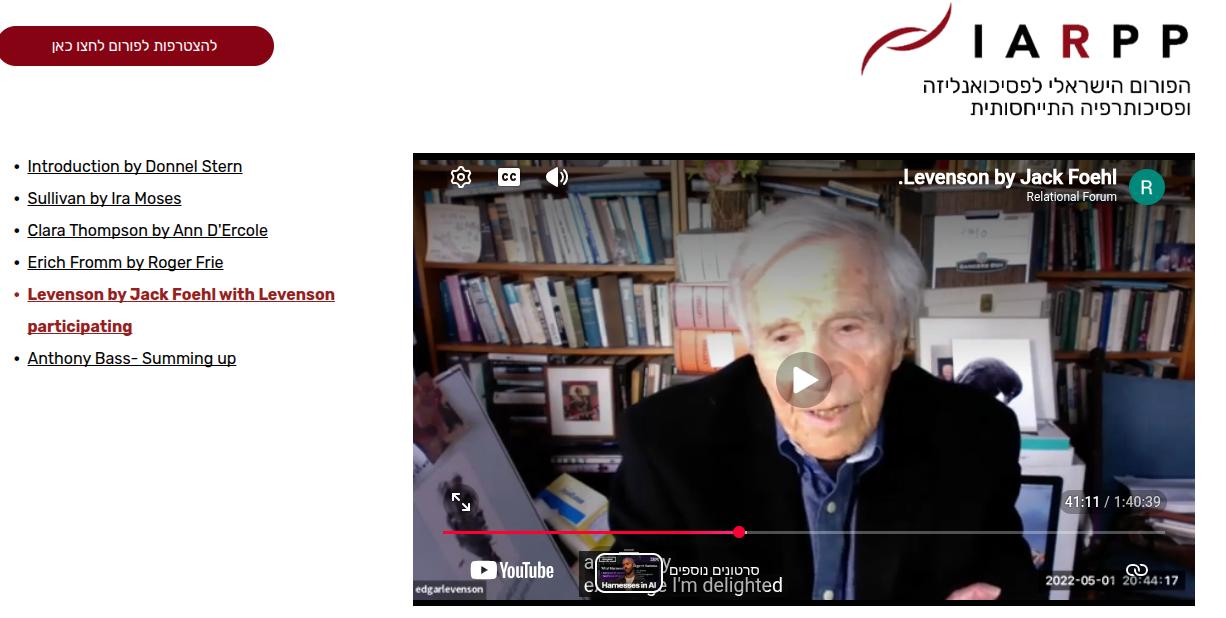
זכינו לארח אותו לפני שנים ספורות, בסדרה הבינלאומית שלנו על האינטרפרסונלים. זו הייתה חוויה וזכות גדולה.הקלטת המפגש עימו גם היא מצורפת.
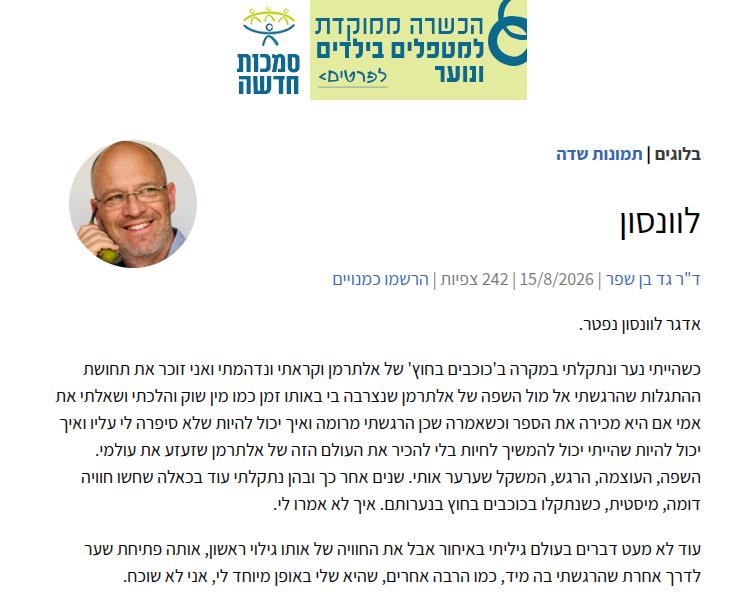
מוזמנים לקרוא למטה את הדברים המאירים שכתב חברנו גדי בן-שפר לזכרו, וכן דברים של חברים אחרים מהגישה האינטרפרסונלית. מצורף מטה.
שנה חדשה, פעילויות חדשות.
ב-9 בספטמבר, כ"ז באלול, נחל ב- "דיאלוג חי – בין החשיבה הפסיכואנליטית למקורות יהודיים", סדרת הזום החדשה שלנו.
הסדרה התמלאה מהר, והתגבשה קבוצה מעניינת והטרוגנית של משתתפים ומשתתפות. אנחנו מחכים ומחכות לצאת לדרך.
בין ה-11 ל-18 בנובמבר נקיים את הקולוקוויום השנתי שלנו. פרטים מלאים ואפשרות להרשמה חינמית בניוזלטר הבא.
אבל נספר כבר עכשיו שנעסוק במאמרה העשיר והמרתק של ד"ר שרון שטרסבורג – "פעולה בטיפול – חידה או פתרון? על תנועה בין הגופני לסימבולי בטראומה".
יש לנו הרגשה שהמאמר הוא הזמנה ל"צלילה עמוקה" לנושאים רבים.
יאיר הררי, בשירו העוצמתי "יש מקום", כותב:
"ילד משחק בצעצועי כאב,
מרכיב ומפרק,
לומד איך לאהוב."
שיהיה לנו מקום לפרק ולהרכיב, להשתנות,
שנלמד לאהוב שוב.
בברכת שנה חדשה,
אודי חן
יו"ר הפורום ההתייחסותי, בשם הוועד
החודש בניוזלטר:
- מכתב חשוב לחברי הפורום.
- Call for Papers and Panel Proposals לכנס ה-23 של IARPP.
- לזכרו של אדגר לוונסון.
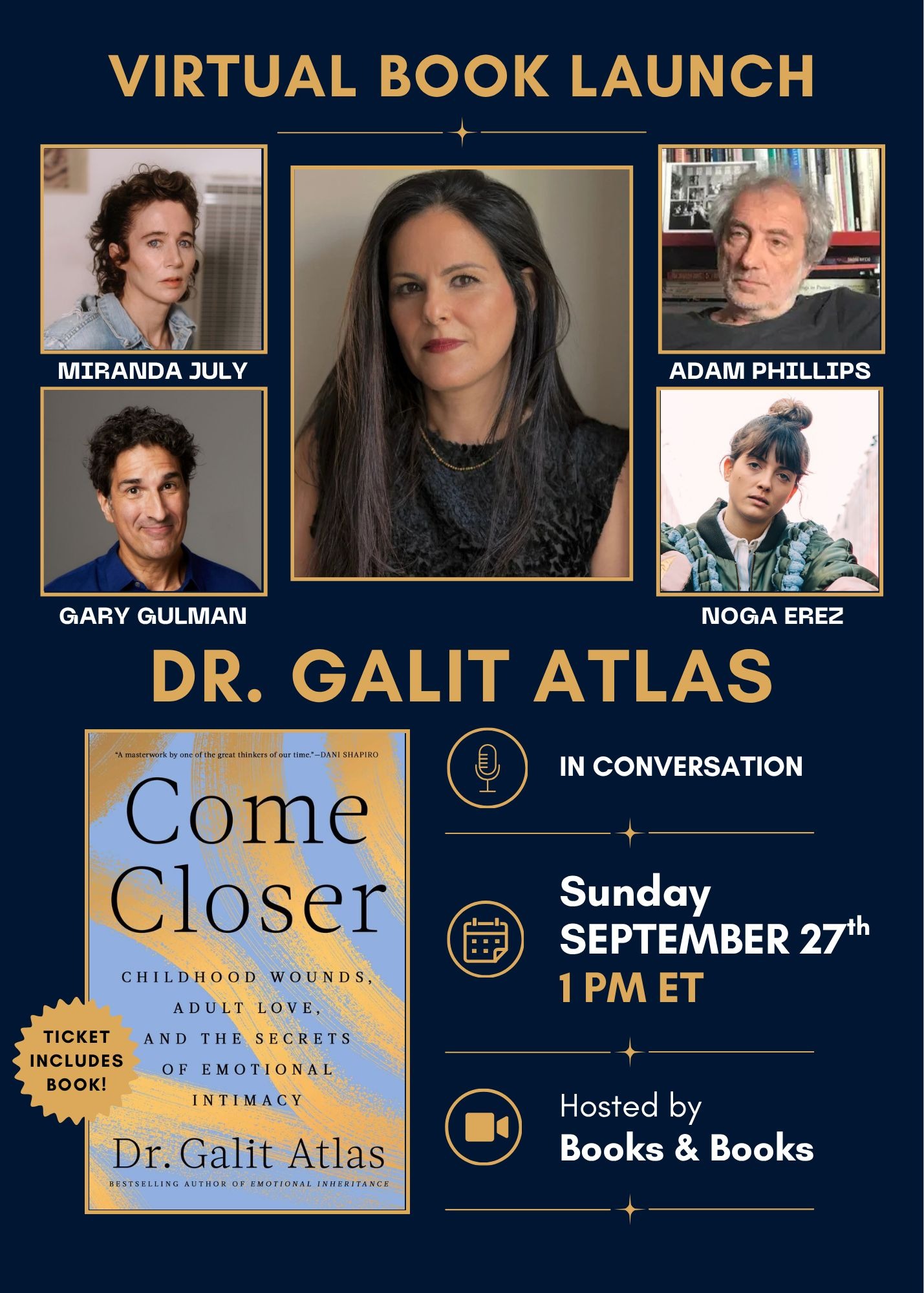
- השקת ספרה של ד"ר גלית אטלס.
- השקת ספרה של ד"ר נטע גוטמן-אבנר.
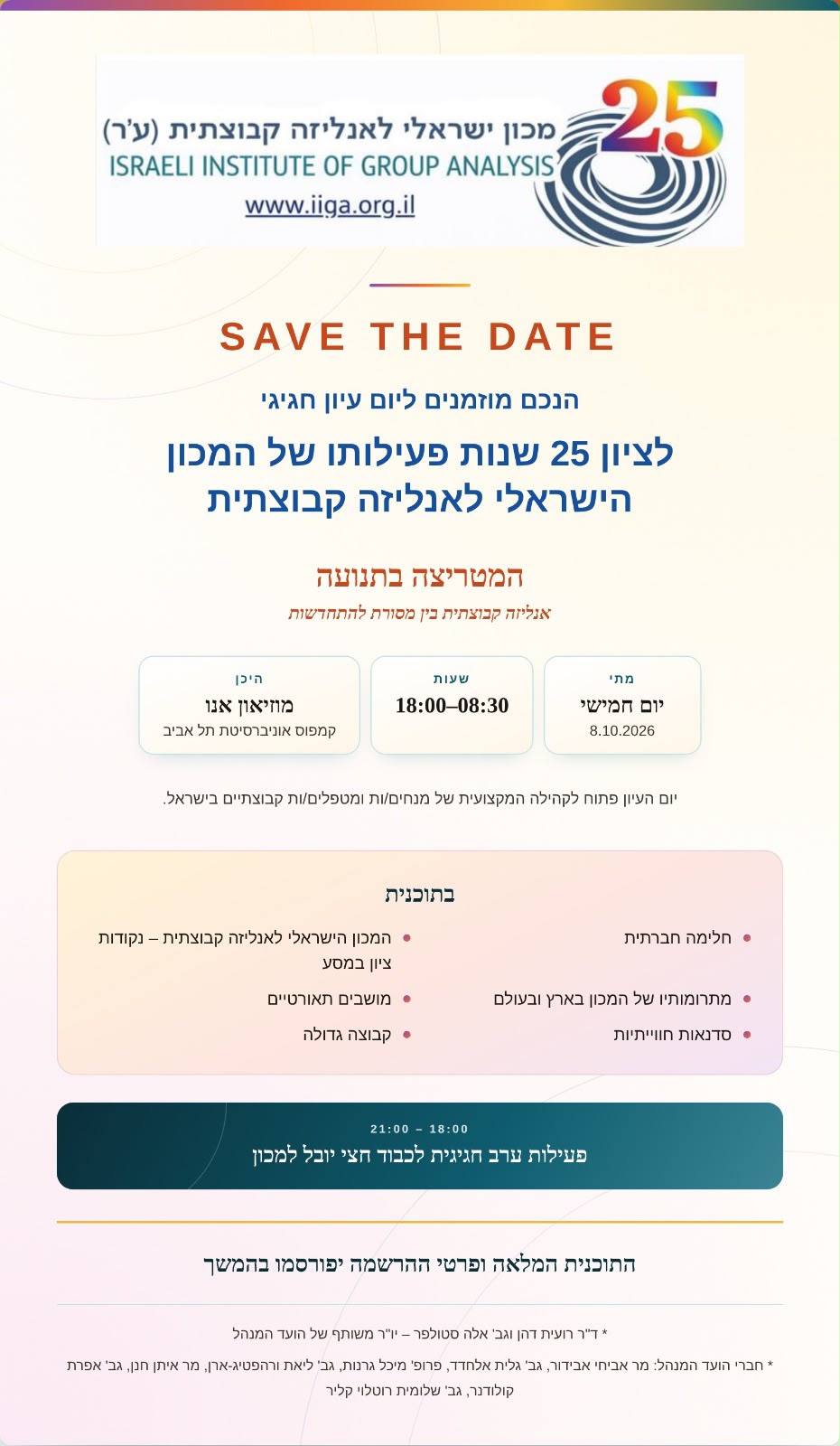
- Save the date - ארוע לציון 25 שנות פעילות של המכון הישראלי לאנליזה קבוצתית
נשמח לראותכם/ן בפעילויותינו
מהחברות והחברים בועד הפורום
אבי אפרתי,
אודי חן (יו"ר),
גיטי פיין, ד״ר ריקי פלח-גליל, מנאל עוסמאן,
סיגל פלינט, גילי לוטרינגר
חברים נלווים - אליס בר נס, מאי סאדאר, אלעד קמחי
אודי חן
I am a seasoned clinical psychologist, clinical academic lecturer, and long‑standing member of IARPP since its inception, active in both my local chapter and on the Board. As I stand for a second term, I hope to continue contributing to the evolution of our organization. With relational thinking now 45 years old and IARPP celebrating its 25th anniversary, this is a moment that invites reflection. Over the years, I have gained a broader perspective on how our structures support—and at times constrain—our growth. Like any mature organization, we live within a dialectic between tradition and innovation, yet I believe the balance has tilted too far toward tradition, limiting our capacity to adapt.
Patterns such as the under‑representation of our largest chapters (Oceania (0) and Greece (1)), the diminishing place of large‑group work in our conferences, and the steady decline in U.S. membership all point to areas where greater organizational responsiveness is needed. In my view, these challenges stem largely from structural factors, including the permanent presence of five founding members on a Board of roughly twenty, many of whom hold influential roles on key committees. Their contributions are invaluable, yet the combination of permanence and concentrated influence can unintentionally restrict flexibility and renewal.
If granted a second term, I will continue advocating for thoughtful structural evolution that keeps IARPP vibrant, inclusive, and forward‑moving. If you would like me to keep representing these objectives and work collaboratively toward a healthier balance between tradition and innovation, I would be grateful for your vote.
המכתב המתוקן שהועבר:
I am a seasoned clinical psychologist, clinical academic lecturer, and long-standing member of IARPP since its inception, active in both my local chapter and on the Board. As I stand for a second term, I hope to continue contributing to the ongoing evolution of our organization. With relational thinking now 45 years old and IARPP marking its 25th anniversary, this feels like a natural moment for reflection on how we can continue to grow. Like any mature organization, we navigate a dialectic between tradition and innovation.
My vision is that IARPP will remain a professional home that honors the spirit of its founders while renewing itself in response to a changing world and the diverse communities that compose it. I strive to help create opportunities for our organization's qualitative growth, and I see my role as supporting ways to ensure that all members feel represented. We have meaningful opportunities to strengthen our responsiveness to our global membership, and to deepen professional ties across regions.
IARPP was founded with the aim of opening space within psychoanalysis for flexibility, dialogue, and creative thinking. I hope to continue fostering these values as we grow into the future. If granted a second term, I will work collaboratively toward these aims, helping IARPP remain vibrant, forward-looking, and welcoming to emerging voices.
I would be grateful for your vote.
********** *
IA R PP 23rd Annual Conference
Rome June 24-27, 2027
Alice Through the Looking Glass: Embodied and Disembodied Presence in the Clinical Encounter
Conference Co-Chairs:
Fabia Banella , Susanna Federici, Gianni Nebbiosi, Maria Silvia Soriato
International Committee
Tony Bass, Hazel Ipp, Steven Kuchuck, Margaret Mitchell, Sandra Toribio-Caballero
Local Committee
Michele Argalia, Cecilia Belardelli, Sara Biondi, Rosetta Castellano,
Laura Frigau, Margarita Kahn, Lucia Maiorino, Walter Monterosso, Carmine Schettini,
Alice Sommatis, Daniele Stevens, Paolo Stramba-Badiale, Maria Tammone
Thursday, June 24 – Sunday, June 27, 2027
Rome, Italy
Call for Papers and Panel Proposals
The 2027 IARPP Conference invites us to step through the looking glass and enter a new landscape of human experience—one where the familiar coordinates of presence, embodiment, and relationality have undergone profound transformations and driven by interactive devices, artificial intelligence, and digital environments.
In contemporary clinical thought, the body is no longer viewed merely as a container for experience but is widely recognized as a fundamental participant in the co-construction of meaning. However, research into implicit relational knowing, embodied cognition, affect regulation, and trauma invites us to continually re-examine how the body communicates, remembers, is inhabited, and inhabits experience.
We are ceaselessly immersed in worlds where technology increasingly permeates our relationship with otherness—with the human and the non-human, with challenge and surrender, with life and death—and where the body is traversed, extended, manipulated, and reshaped by interfaces, images, and information flows. Furthermore, the digital transformation of human experience is reshaping how communities are formed, how social bonds are maintained, and how collective identities are negotiated. These changes invite us to think not only about the shifting nature of individual subjectivity but also on the unconscious processes that organize our sense of belonging and interdependence.
The consulting room is no exception. The rapid spread of online psychotherapy and psychoanalysis as well as, of artificial intelligence platforms, alongside developments in neuroscience, challenges us to rethink what it means to encounter the other in analytic work. How do we understand presence when bodies are physically absent yet visible and audible—affectively alive—within the therapeutic space? What is created, what is transformed, and what is lost or gained when analyst and patient meet across a screen? How does the digital medium shape experience, relationship, and narrative within the analytic field? What kind of nostalgia might arise at the end of analysis, when shared spaces had only been virtual? What happens when a person relies on dialogue with a chatbot to share their lived experiences, analyze dreams, or entrust parts of their therapeutic journey to AI platforms? And what if the therapist does so? What are the implications—not only for space and bodies, but also for time, the therapeutic setting, creativity, responsibility, and ethics? Should we not, then, speak of a new form of complexity?
This conference aims to explore the possibilities and tensions, the fears and enthusiasms, inherent in the dilemmas of the multiple embodied and disembodied forms of presence. We invite reflections on the role of the patient’s and analyst’s bodies in the therapeutic encounter; on the challenges and opportunities offered by online therapies; on the impact of digital technologies on subjectivity and intimacy; and on how contemporary relational psychoanalysis can engage with embodied and experiential approaches without losing its commitment to complexity and mutuality in rewriting the forms of meaning that define our humanity.
The IARPP Conference—hosted for the third time in Rome, a city that has always been a crossroads of eras and cultures where layers of history and collective memory are constantly renegotiated—urges us to take further steps amidst continuity and change. Like Alice stepping through the looking-glass, crossing a threshold that allows her to enter a different space-time—inverted and devoid of logic, we are invited to enter territories that may initially seem unusual, disorienting, or paradoxical. Yet, it is often precisely in these liminal spaces—between presence and absence, virtual reality and physical reality—that the exploration of new forms of understanding, connection, and transformation becomes possible. After all, Rome reminds us that every transformation stems from an engagement with the past, offering a rich and complex backdrop for exploring how new digital forms of subjectivity and mutuality are transforming human relationality.
We invite contributions that explore these themes from clinical, theoretical, interdisciplinary, cultural, and social perspectives, with the aim of charting paths for psychoanalytic and psychotherapeutic practice.
We welcome all IARPP members to submit PROPOSALS ONLY for individual papers and/or panels pertaining broadly to the conference theme. We encourage those who would like to submit to join IARPP.
Use this link to submit your proposal:
https://iarpp.ce-go.com/call-
To be considered, please follow the below GUIDELINES :
- Paper Abstract/Proposals must be BETWEEN 500 AND 600 WORDS IN LENGTH .
- Panel Abstract/Proposals should include no more than two papers on a chosen topic.
- Panel Abstract/Proposals should be NO LONGER THAN 1200 WORDS IN TOTAL , and should consist of both an overview abstract AND abstracts of individual papers. Quality of writing, originality, integration of theory and awareness of current literature, clinical implications, and contribution to the field will all be considered.
Quality of writing, originality, integration of theory and awareness of current literature, clinical implications, and contribution to the field will all be considered.
The Conference Committee may group individual papers that are accepted for presentation with other papers in any session. Interlocutors/Discussants for panels may be suggested, but cannot be guaranteed.
Please note that while multiple proposals may be submitted, only one presentation per participant will be allowed due to the limited time slots. Proposed submissions cannot have been presented at a previous IARPP conference.
All Proposals are due Monday, October 5th, 2026.
The Conference Committee may group individual papers that are accepted for presentation with other papers in any session. Discussants for panel may be suggested, but cannot be guaranteed. Please note that while multiple proposals may be submitted, only one presentation per participant will be allowed due to the limited time slots. Proposed submissions cannot have been presented at a previous IARPP conference. FINAL PAPERS will only be requested upon the acceptance of your proposal for the conference. Final papers should not exceed 3000 words and will be due by and no later than Monday, March 15, 2027 . All papers are to be submitted in English. Please use this form to submit proposed presentation details.
*** PROPOSAL SUBMISSION PROCESS:
https://iarpp.ce-go.
The deadline for receipt of proposal submissions is MONDAY, OCTOBER 5th, 2026 . No names should appear on your proposal submission as reviews are anonymous . If you have any trouble completing this form please click Send Email for further assistance.
Please use this link to submit:
https://iarpp.ce-go.
- Presentation Title (Please list the overall title if submitting a panel. Please list individual paper titles in the abstract section for all papers in Panel submission.
- One paragraph Abstract and THREE Educational Objectives for your presentation (These statements must clearly describe what the learner will know or be able to do as a result of having attended your presentation. Learning objectives must be observable and measurable (e.g., list, describe, apply, analyze, assess, utilize, critique, etc.)
- Current Curriculum Vitae AND a one-paragraph Bio Sketch of current professional work.
- Content References for your presentation (provide a minimum of 5 resources (within the past 5 years) used to research the topic and/or for further reading by the attendee. In addition, at least 3 resources (within the last 10 years) must have overall consistent and credible empirical support in contemporary peer reviewed scientific literature (journals). This must be formatted in an APA format. At least 5 content references are required.)
- Completed proposal as described above with author’s name removed .
BEFORE SUBMITTING PLEASE NOTE:
Each prospective presenter should use one email. Whichever email the primary presenter adds FOR THE CO-PRESENTERS when adding them to the PROPOSAL FORM is the one they must use to gain access to the form.
If a presentation is submitted before co-presenters have had the chance to add their information, it will need to be withdrawn to ensure they can complete the form accurately. PLEASE CONTACT CONFERENCE MANAGER AT nilou@km-direct.com IF YOU ENCOUNTER THIS ISSUE. The platform will save all your information, so you can withdraw and resubmit as needed without losing your progress.
Due to continuing education application requirements, all of these materials must be submitted in order for your proposal submission to be reviewed. We regret that presentations submitted without all of the above items cannot be considered. All proposal submissions will be reviewed by the Program Committee. Authors will be notified of the Committee’s decision by mid- to late-November . Acceptance is limited by space availability.
Paper and/or Panel Submission deadline is MONDAY, OCTOBER 5TH, 2026.
********** *
לזכרו של אדגר לוונסון
לחצו כאן לצפייה בראיון עם דונל סטרן במסגרת הסדרה של הפורום - האינטרפרסונלים:
********** *
********** *

********** *
חברינו מהמכון הישראלי לאנליזה קבוצתית מזמין: